Retrospective voting in the Italian 2013 election: a sub-national perspective

Italian political science review (2017)

The Italian 2013 election ended the period of bipolarism that characterized the so-called ‘Second Republic’, and paved the way for new parties such as the Five Star Movement.
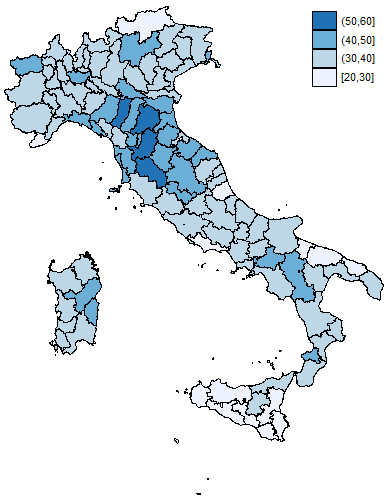
We investigate that election, which took place after the technocratic government led by Mario Monti, through the analytical lenses of the retrospective theory of economic voting applied at the provincial level. Local unemployment rates shape the electoral performances
of those parties that were more supportive and sympathetic to the caretaker executive, thus confirming a distinction between incumbent and non-incumbent even in that critical and politically undecided election. We further contribute to the literature on retrospective voting by relaxing the locally untenable assumption of independence among the units. Making use of spatial regression models, we demonstrate the relevance of both the internal  and contiguous economies, and their relative impact due to the different size of the provinces.

***Data

The economic vote at the party level: Electoral behaviour during the Great Recession

Party politics (2017) with S.A.Massari

The Great Recession is a non-trivial test bed for the theory of  economic voting, especially if its predictions are decomposed at the party level, as done in this article by analysing the electoral performances of parties competing in 89 national elections held in the 28 member states of the EU between 2003 and 2015. We acknowledge counterintuitively that prime ministers’ parties are able to exploit the relatively good state of the economy, while sharing the blame with their allies in times of crisis, counting on the lack of clarity in the attribution of responsibilities and deploying their heresthetic capacities. We further recognize that new parties, more than opposition ones, proportionally profited from the recession. Tough times magnify the alternation between left- and right-wing victories, without necessarily favouring the most radical parties, whereas the EU’s supposed responsibility in prolonging the crisis fuelled the success of Eurosceptic parties.

*** Dataset

PRIN 2015: POLcrises @ Europe – studying crises during the crisis

PRIN PROJECT – POLCrises@Europe

This project aims to analyse the impact that the Great recession had on the political and policy dynamics in the European context.

The three workpackages, that involve research groups across 7 Italian universities,  focus respectively on the input side of the political system (analysing the process of political representation, parties and movements, and electoral behavior), on the institutional black box (mainly legislatives and executives, and on their relationship in diverse settings), and on the output side  (investigating the capacity to adopt structural reforms, and analysing more specifically taxation, labour, pension and health policies).

For more info, click on the heading